One of the things that bothers the teachers and other school staff I work with is that memory loss disrupts their flow in the classroom.
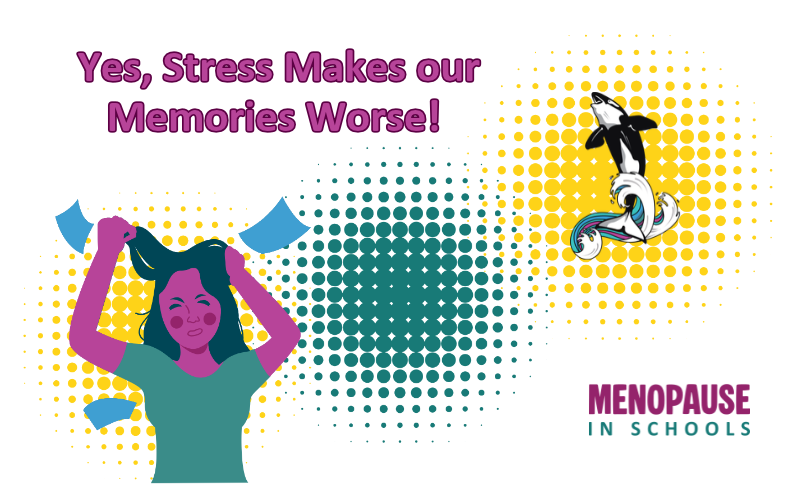
The element of this is stress. A recent study shows that stress stops your brain joining the dots. It affects memory because it stops us making the connections that allow us to remember or memorise things.
The study gave people two associated images and then asked to infer a third idea based on both. The example given is a friend with a Vespa, the same Vespa outside a library and the assumption that their friend was inside. Between giving them ideas one and two, participants were given a psychosocial stressor and that ability to infer the third idea tested. At the same time activity in the hippocampus was monitored with a Functional MRI.
Many of us are acutely aware of the fact that our retrieval gets harder as we go through menopause - the words that disappear, the way we walk into rooms with no idea what we were going to do. You may even be reading this because you picked up your phone to do something completely different!
But this study is about the way we connect memories and infer things - crucial to the way we learn things and pick up what's going on around us.
The new tech that's impossible to learn. The lost ability to size up a situation quickly and respond. Split second decisions that now seem to take forever.
And I'm willing to bet that though this study focuses on our ability to connect that our ability to store and retrieve memories is also affected by stress. That's certainly what many of us experience. If we get upset about remembering a word, it'll take longer to remember. The more flustered we are, the more chance there is of our to-do list becoming a to-whit-to-woo list.
We also know that the hippocampus - which was observed here - is affected by hormone changes in perimenopause. Lisa Mosconi's work shows this beautifully. So if you are dealing with perimenopause and you are experiencing constant stress - and let's be honest, schools are full of psychosocial stressors - then you have a double whammy.
So, as well as doing whatever you can to even out those hormones - whether that's HRT or boosting your gut biome - it's also really important to find new and effective ways of managing stress.
Maybe it's talking a walk in the park, having a laugh with friends, or sitting with a purring cat on your lap. Meditation and mindfulness can also be very effective in perimenopause. It's not important how you chose to manage stress as long as is it works.
What is important is to realise that these things are not luxuries, or treats. They make your brain work better. And your brain needs to work for you to do your job.